
At a glance
- Book a morning Louvre visit, then continue to the Tuileries and Opéra area.
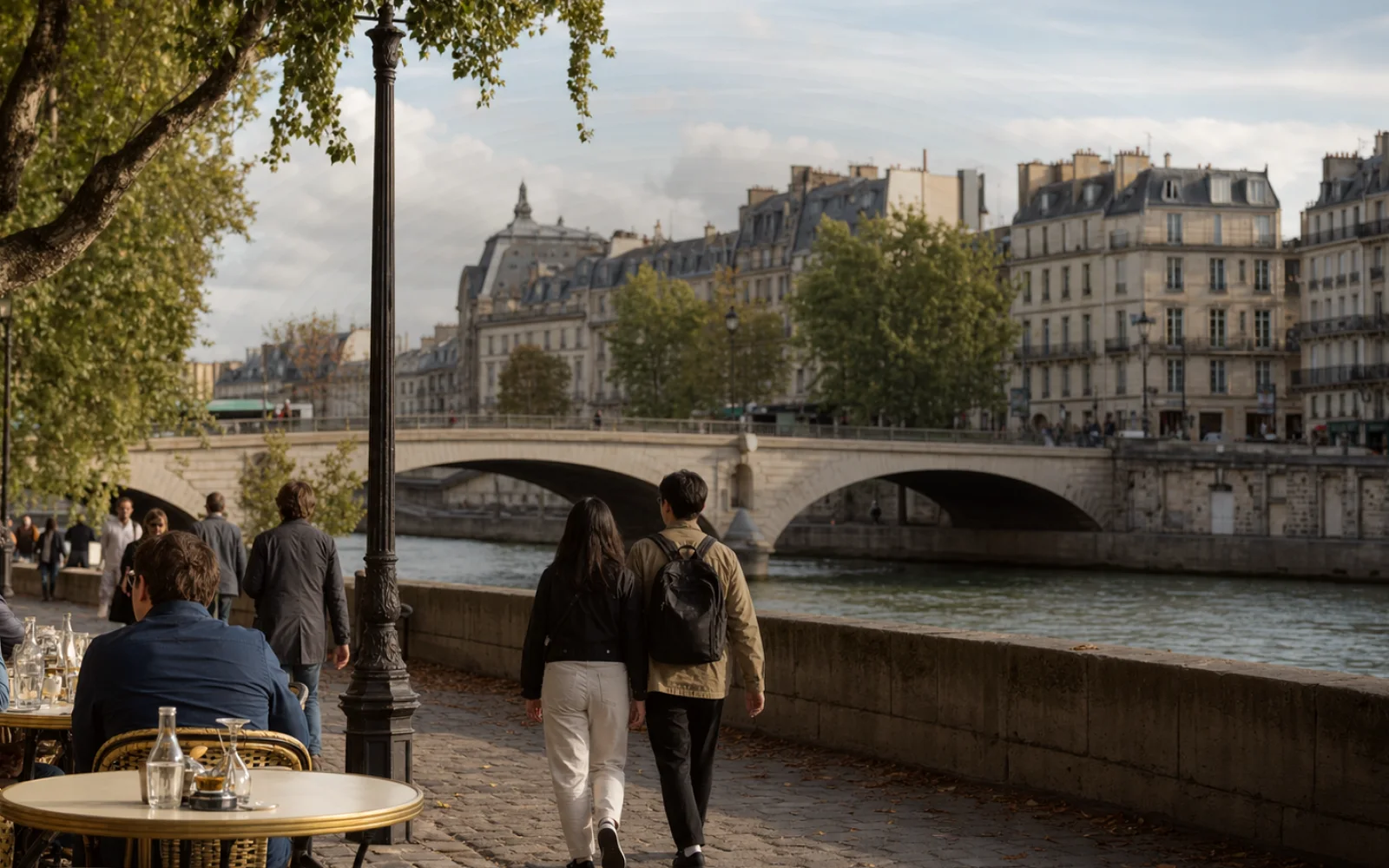
- Pair the Musée d’Orsay with a walk along the Seine for a well-paced day.
- Le Marais and Montmartre offer different experiences: shopping, cafés, and views.
- If you can’t get a reservation for the Louvre or Musée d’Orsay, choose an alternative in the same area. If it rains, pair covered arcades with a small exhibition that’s open. If the lower Seine pathways are closed, follow the official detour along the upper roads.
Day by day
Suggested itinerary
See each day's route, highlights, background and stay together in one place.
Drop off your bags, then walk around Île de la Cité and the Latin Quarter for just 1–2 hours. If you arrive late, limit the evening to dinner near your accommodation.
Allow 30 minutes before your reserved entry, then spend 3 hours at the museum, have lunch, and walk for 1–2 hours around the Tuileries and Opéra area. Don’t add Versailles.
Spend 3 hours at the Musée d’Orsay, then eat and walk around Saint-Germain. If you still have energy that evening, choose just one spot at Trocadéro to view the Eiffel Tower from outside. Eiffel Tower tickets require a separate reservation.
Only take a short look around Le Marais or Montmartre if you have a late afternoon departure and enough time for your luggage and airport transfer. If your flight is in the morning, retrieve your bags and leave without sightseeing. Don’t commit to a half-day on the hills before calculating your airport transfer.
History and context
The Louvre and Tuileries show Paris’s history as it changed from a royal city to one shaped by its citizens.
The Musée d’Orsay and Montmartre shaped Paris’s image as a city of artists from the 19th century onward.
Places and meals
For your first visit, focus on a smaller selection of the best-known works.
Google MapsA museum where you can see Impressionist art and railway-station architecture together.
Google MapsA neighborhood for a walk among hills, a basilica, and streets associated with artists.
Google MapsFood and restaurants
- Mix brasseries, bistros, crêperies, and bakeries for a good balance of cost and experience.
- Restaurants near museums get busy, so save options one block away.
A good place to experience the atmosphere of a casual Paris restaurant.
Paris Google MapsA good place to stop for a crêpe while walking around Le Marais.
Le Marais Google MapsA good option for a simple steak-frites meal.
Saint-Germain Google MapsHow to fit it in
Choose your museum reservation days first, then plan walks in the surrounding areas.
Reality check
For the Louvre, use Palais Royal–Musée du Louvre station and the entrance specified on your booking confirmation. For the Musée d’Orsay, use Solférino or the Musée d’Orsay station on RER C. Use RATP to look up the route from your accommodation address to your departure terminal for your travel date and time, distinguishing between CDG and ORY airports. Don’t assume the RER B to CDG and transport to Orly use the same ticket or station.
Allow 3 hours to visit each of the Louvre and the Musée d’Orsay, plus 30 minutes for entry and 1 hour for lunch, and visit them on different days. After the Louvre, spend just 1–2 hours walking around the Tuileries and Opéra area. After the Musée d’Orsay, do the same in Saint-Germain. On departure day, aim to finish sightseeing 5–6 hours before an international flight. Calculate your departure allowance by totaling 30 minutes to retrieve your bags, 60–90 minutes to travel from your accommodation to the terminal, and the arrival buffer recommended by your airline. Allow more time if there are transit disruptions or you’re staying outside the city center.
According to official information as of October 3, 2026, a general Louvre ticket costs €32 for visitors who aren’t EEA citizens or residents and €22 for EEA citizens and residents. Check the required proof and eligibility for free admission. A standard online ticket for the Musée d’Orsay costs €16, so a non-EEA adult would pay €48 for both museums. Add 3 nights of accommodation, 4 days of meals, local and airport transport, and any Eiffel Tower ticket you choose. Check timed-entry requirements and eligible venues separately if using a museum pass.
Walk past touts near the Montmartre steps and the Eiffel Tower lawns, and put your phone away near subway doors.
If plans change
Switch to a garden, church, or small museum nearby, and don’t buy an available timed-entry ticket on the other side of the city just to fill the gap.
Skip lower riverside paths and boat cruises; link arcades, museums, and cafés along a single metro line.
Small tip
Don’t visit the Louvre and Versailles on the same day; leave time for a relaxed walk around Paris.
Final check before departure
- Make whichever museum you booked—the Louvre or the Musée d’Orsay—the anchor for the day. Check its official page for your entry time and last admission.
- On a day you visit the Eiffel Tower, check the official ticket site for available time slots first, then add a walk in Saint-Germain or Trocadéro before or after.
- Check RATP for service notices and planned work affecting the station near your accommodation and your airport transfer route on the day you travel.
Opening hours and timed-entry slots for the Louvre, Eiffel Tower, and Musée d’Orsay vary by date and may sell out. Metro construction and event-related restrictions can also affect travel. Plan each day around one paid reservation and keep to that area.
Information checked: 2026-10-03