
At a glance
- From April 20, 2026, flights departing South Korea allow no more than two power banks in total, regardless of capacity. Each must be rated at 160Wh or less. This quantity limit is separate from the rules for replacement batteries fitted into cameras or laptops.
- Units rated at 100Wh or less do not require airline approval, but damaged, swollen, or recalled products may be refused. Units above 100Wh and up to 160Wh require airline approval even within the two-unit limit. Power banks above 160Wh cannot be brought onto passenger aircraft.
- ICAO's current 2026 rules permit power banks above 100Wh and up to 160Wh with airline approval. IATA's 2026 guidance explains that this exception is not expected to appear in the 2027, 68th edition of the Dangerous Goods Regulations. Therefore, 100Wh must not be presented as an absolute limit that already applies to every country and airline in 2026.
- Korean Air, Asiana Airlines, Jeju Air, Air Busan, Jin Air, Air Seoul, and T'way Air prohibit using or recharging power banks on board and storing them in overhead bins. However, the quantity limits shown on individual airline websites differ in update timing and presentation. Follow the ministry's current two-unit limit first, then check the airline's notice again immediately before flying.
- If only mAh and voltage are shown, with no Wh rating, calculate Wh by multiplying mAh by voltage and dividing by 1,000. For example, a 10,000mAh, 3.7V unit is 37Wh. Use the rated voltage printed on the product; substituting the USB output voltage can change the result.
Four steps before departure
Check capacity, then work through to cabin storage
Failing even one requirement may mean removing the unit from your packed bag at the airport.
-
1. Capacity
Find the Wh rating
Units up to 100Wh require no approval; those above 100Wh and up to 160Wh require airline approval. Do not bring units above 160Wh or with an unverifiable capacity.
-
2. Quantity
No more than two in total
Even when mixing small and large units, each person may carry no more than two power banks.
-
3. Individual packing
Protect each unit separately against short circuits
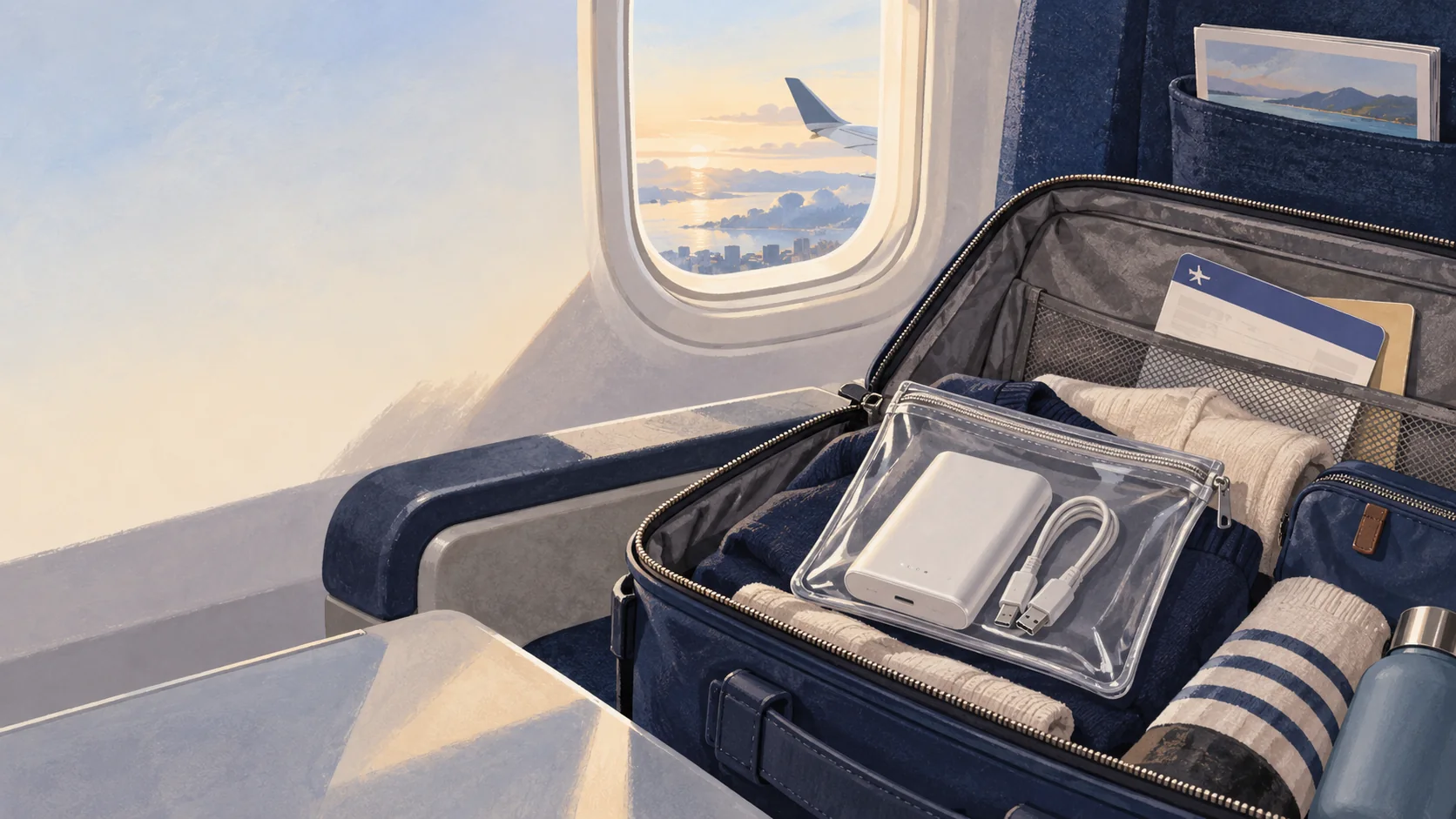
Insulate each unit's terminals and USB ports, or use one resealable bag or protective pouch per power bank.
-
4. No use on board
Keep it within reach and do not use it
Keep it on your person or in the seat pocket in front of you, not in an overhead bin. Both recharging the power bank itself and using it to charge another device are prohibited.
Practical checklist
What to do at the airport and on board
Check capacity and packing at home, and show units requiring approval to the airline before security screening.
Find the Wh rating on the product or in its manual. Do not bring it if it exceeds 160Wh or its capacity cannot be verified. Also remove from your bag any unit that is swollen, cracked, badly dented, shows signs of liquid, or is subject to a manufacturer recall.
Limit the power banks you bring to two. Cover each unit's terminals and USB ports with insulating tape, or put each one in its own resealable bag or protective pouch. Do not mix them with metal objects such as keys or coins.
If you have a unit above 100Wh and up to 160Wh, check the airline's approval procedure before departure. At the airport, visit the check-in counter before security, show staff the units' Wh ratings and quantity, and follow their instructions.
Do not put power banks in checked baggage or overhead bins. Keep them on your person or somewhere you can see them immediately, such as the seat pocket in front of you. During the flight, do not recharge the power bank or use it to charge a phone or laptop.
First decision before packing
First, check the Wh rating printed on the power bank. It is safer to leave behind any unit rated above 160Wh or with an unverifiable capacity. For units above 100Wh and up to 160Wh, ask your booked airline about approval procedures in advance, and follow the check-in counter's instructions at the airport.
Capacity, quantity, and storage
Power banks cannot be checked in. If your carry-on bag is checked at the gate, remove the power banks first and carry them with you. Once on board, keep them within reach rather than in an overhead bin.
The current official pages of Korean Air, Asiana Airlines, Jeju Air, Air Busan, and Air Seoul reflect the two-power-bank limit. Jin Air's April 2026 notice presents its detailed table mainly as an image, making the quantity difficult to recheck from text alone. At the time of checking, T'way Air's restricted-items page still showed the former five-unit limit, conflicting with the ministry's current two-unit rule. Check the latest notice or contact customer service before departure, including for Jin Air and T'way Air.
Do not decide whether a unit is allowed based on mAh alone. The same mAh rating gives different Wh values at different voltages. The formula is Wh = mAh × V ÷ 1000. At 3.7V, 20,000mAh equals 74Wh, but use the product label's Wh rating and rated voltage for the actual decision.
If a power bank becomes hot or swollen, or produces smoke, an unusual smell, or noise, do not keep handling it or bury it deep in your bag. Notify cabin crew immediately and follow their instructions. If it falls into a seat gap, call the crew rather than moving the seat to retrieve it.
If plans change
For flights departing South Korea, first observe the ministry's current limit of two. Airlines may impose stricter limits, so also follow the operating airline's latest notice and airport instructions.
Confirm it is rated at 160Wh or less, then tell the airline the product name, Wh rating, and quantity and ask how to obtain advance approval. If approval is not confirmed, it is safer to switch to a unit rated at 100Wh or less.
Finish charging at the airport before boarding, and use power-saving and airplane modes. Follow the airline's and aircraft's guidance on charging electronic devices directly from a seat USB port or outlet, but do not connect the power bank itself.
Do not apply South Korea's departure rules to your entire round trip. For each leg, check whether the operating airline or departure country requires a lower capacity limit or a specific certification marking.
Small tip
Keep each power bank's terminals and USB ports from touching metal objects. Cover them with insulating tape, or put each unit in its own resealable bag or protective pouch. Placing two units loose in the same pocket does not count as individual packing.
Final check before departure
- Check the Wh rating and condition of every power bank.
- Reduce the total to no more than two units.
- Arrange airline approval for units above 100Wh and up to 160Wh.
- Insulate each unit's terminals and USB ports, or pack each one separately.
- Remove power banks from checked baggage and put them somewhere easy to reach in your carry-on.
- Check the operating airline's latest notice and any additional restrictions in the departure country.
- Do not use or recharge power banks on board, or put them in overhead bins.
On flights departing South Korea, power banks cannot go in checked baggage. Each passenger may carry up to two power banks in the cabin, each rated at 160Wh or less. Airline approval is required for units above 100Wh and up to 160Wh. Your airline or departure country may have stricter rules, so check the operating airline's latest notice before departure.
Information checked: 2026-10-07