
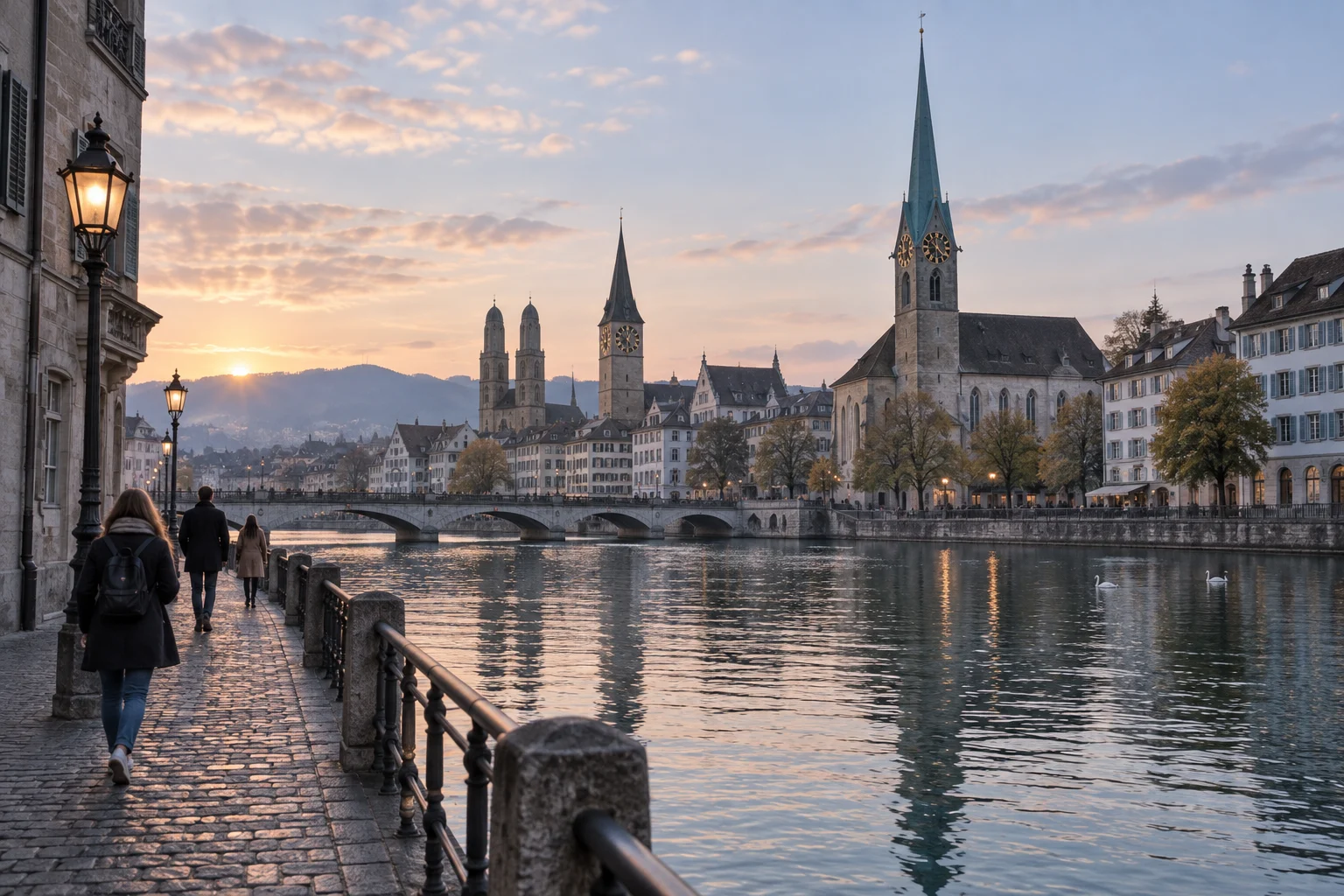
At a glance
- The name Fraumünster comes from the site’s history as a women’s abbey. Today, it serves as a worship space for the Reformed Church of Zurich.
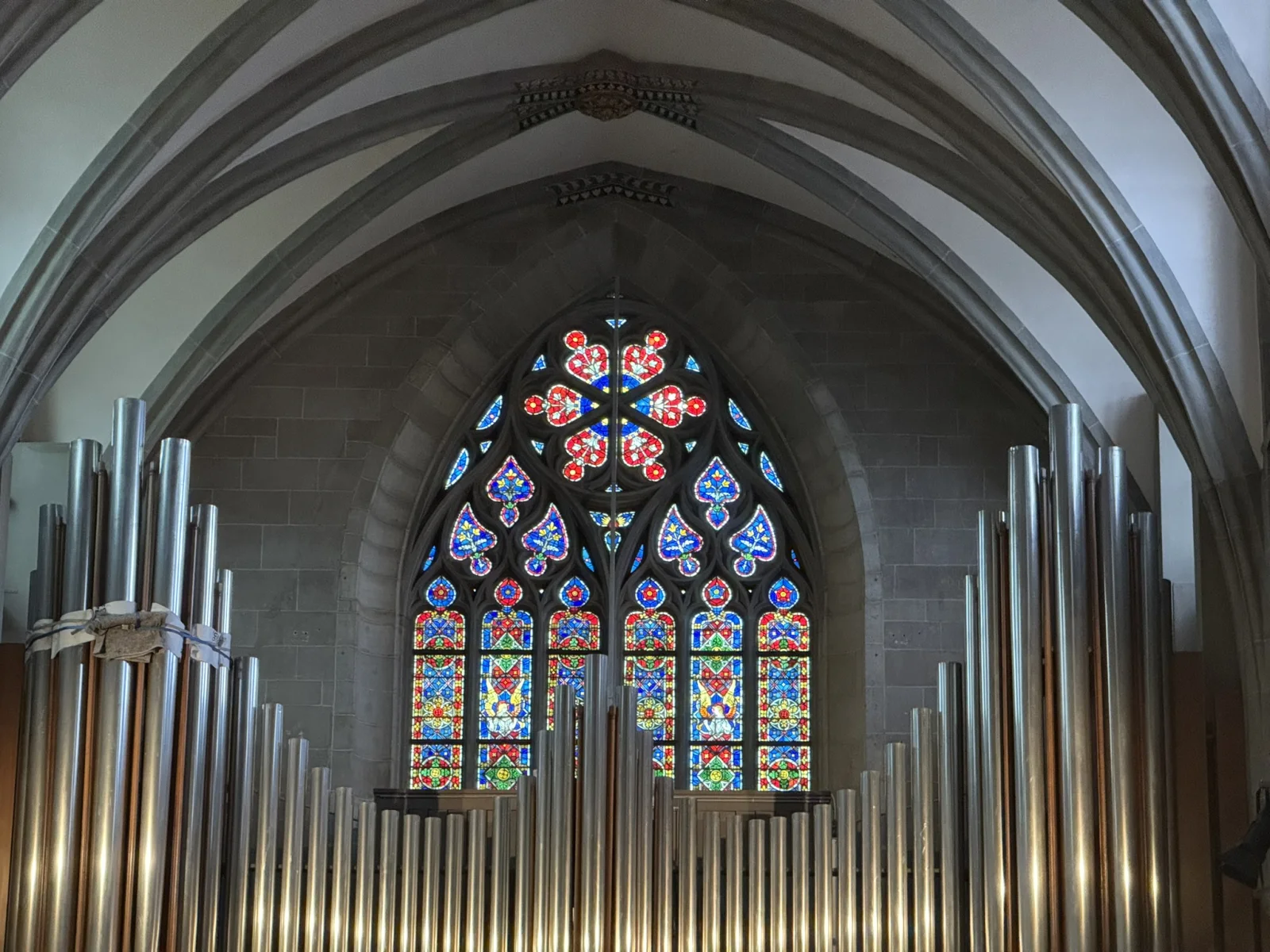
- The large organ on the west side was installed in 1953. Behind it is a stained-glass window made in 1914 by English stained-glass artist Clement Heaton. Organ pipes block the lower part, so focus on the design above them.
- The organ is the largest in the Canton of Zurich, with 5,793 pipes and 95 stops. Visitor routes and hours may change on days with services or concerts.
Day by day
Suggested itinerary
See each day's route, highlights, background and stay together in one place.
Look at the five choir windows and follow the Bible scenes through their colors. Then turn your attention to the south transept to find the 1978 rose window.
It takes 2–3 minutes to walk indoors from the entrance to the choir.
Look for the mural showing the sisters Hildegard and Berta with a deer whose antlers hold glowing candles. According to the legend, the deer led the sisters to the site of today’s church.
Allow 5–10 minutes to look carefully at the murals around the choir.
Take the entrance to the left of the choir down to exhibits showing the early abbey walls and the extent of the underground space. You can also see videos and materials about the abbey’s growth and the Reformation.
Allow 10–20 minutes for the highlights of the underground exhibits. Leave space between yourself and others on the stairs and in narrow passages.
Turn toward the west to see Heaton’s window through the metal pipes. Comparing Chagall’s expressive figures with the 1914 window’s medieval-style patterns makes the differences between the stained glass clear.
Allow about 5 extra minutes on your way back to the exit.
현장 사진
History and context
Louis the German, king of East Francia, founded a women’s abbey here for his daughters Hildegard and Berta. Tradition remembers the sisters as the abbey’s first abbesses.
In the Middle Ages, an abbess was more than a religious leader. She held the rights to mint coins, collect tolls, and hold markets, and influenced Zurich’s laws and civic affairs until the 14th century.
In 1524, during the Reformation, the last abbess, Katharina von Zimmern, transferred the abbey’s documents, property, and rights to the city of Zurich. The contemporary document records the transfer as voluntary, and it took place without armed conflict. The remaining governing powers were settled by 1526.
According to legend, a deer with burning candles on its antlers led Hildegard and Berta. The sisters followed it to the place where Fraumünster was built, and the church mural preserves the scene.
Marc Chagall completed the five choir windows in 1970. Their colors connect scenes from Genesis, the prophets, Moses, and the life and resurrection of Jesus, showing humanity’s path to salvation. In 1978, he created the rose window in the south transept.
During renovation work in 1900, traces of old underground spaces were rediscovered beneath the choir. After serving as storage for a time, the area opened as an underground museum following renovations in 2016.
Places and meals
The five tall windows date from 1970, and the round rose window to the south dates from 1978. Instead of focusing on one scene up close, step back a few paces first and see how the colors spread across the entire choir.
Google MapsFinding the two sisters and the glowing deer brings the story of the abbey’s founding in 853 into view. The niche below the mural is said to hold the sisters’ remains.
Google MapsThe museum shows walls believed to belong to an early 9th-century building and changes to the underground spaces in the 11th century. The entrance is to the left of the choir, and admission is included in the general visitor ticket.
Google MapsThe 1914 Heaton window is visible above the organ pipes. From a distance, look for its four angels and geometric patterns.
Google MapsHow to fit it in
After entering, start with Chagall’s choir windows. Next, find the foundation legend mural showing the two sisters and the glowing deer, then take the entrance to the left of the choir down to the underground museum. This route connects the medieval abbey, the Reformation, and modern art in one story.
Reality check
It takes about 15 minutes to walk from Zurich Central Station along Bahnhofstrasse and through Münsterhof. Take a tram to Paradeplatz and walk about 5 minutes, or cross Münsterbrücke from Helmhaus on the other side of the river. The address is Münsterhof 2, 8001 Zürich.
Allow about 30 minutes for a quick visit to Chagall’s windows, the mural, and the underground museum. Plan for 45–60 minutes if you also see Heaton’s window and listen to the audio guide. Last admission is 15 minutes before closing, so a late arrival may leave too little time for the underground exhibits.
Admission for visitors is CHF 5 for adults. Buy tickets on-site with cash, card, or TWINT; no advance booking is needed. The underground museum and an audio guide or printed guide are included. Admission is free for visitors 16 and under and for students who show a student ID.
The church is still used for services, so avoid loud conversations and bringing in food. Personal photography is allowed without flash or a tripod, but photos of Chagall’s windows are for private use only. Do not post them publicly, including on websites or social media. Around Münsterhof, step out of the way of trams and bicycles before taking photos.
If plans change
If a service or event is underway, view the exterior from Münsterhof and cross Münsterbrücke for a view of the church from across the river. Check the official special hours, then return later that day, or visit Grossmünster and St. Peter’s Church first.
Ask staff at the entrance which areas are accessible, then learn about the abbey’s history from the murals inside the church and the brief guide. Don’t attempt the narrow stairs if they’re difficult to use.
See the five choir windows and the south rose window, find the foundation legend mural, then visit just the early walls in the underground museum. Skip the audio guide and keep the order of the three stops.
Small tip
Chagall’s choir windows date from 1970, while the south rose window dates from 1978, when Chagall was 90. Don’t mistake them as works completed in the same year: look for the five tall windows and the round rose window separately.
Final check before departure
- Check the regular hours—10:00–18:00 from March to October and 10:00–17:00 from November to February—and the schedule for that day.
- On Sundays, visitor admission starts at 12:00, after the service. Last admission is 15 minutes before closing.
- Prepare to pay CHF 5 on-site, and allow an hour if you plan to listen to the audio guide.
- Keep photos of Chagall’s windows for personal use; don’t post them publicly on a website or social media.
- Save the visit order as Chagall’s windows, the foundation legend mural, and the underground museum.
Official information was rechecked on September 6, 2026. Hours may be shortened for services and events, so check for special hours again shortly before your visit.
Information checked: 2026-09-06