
At a glance
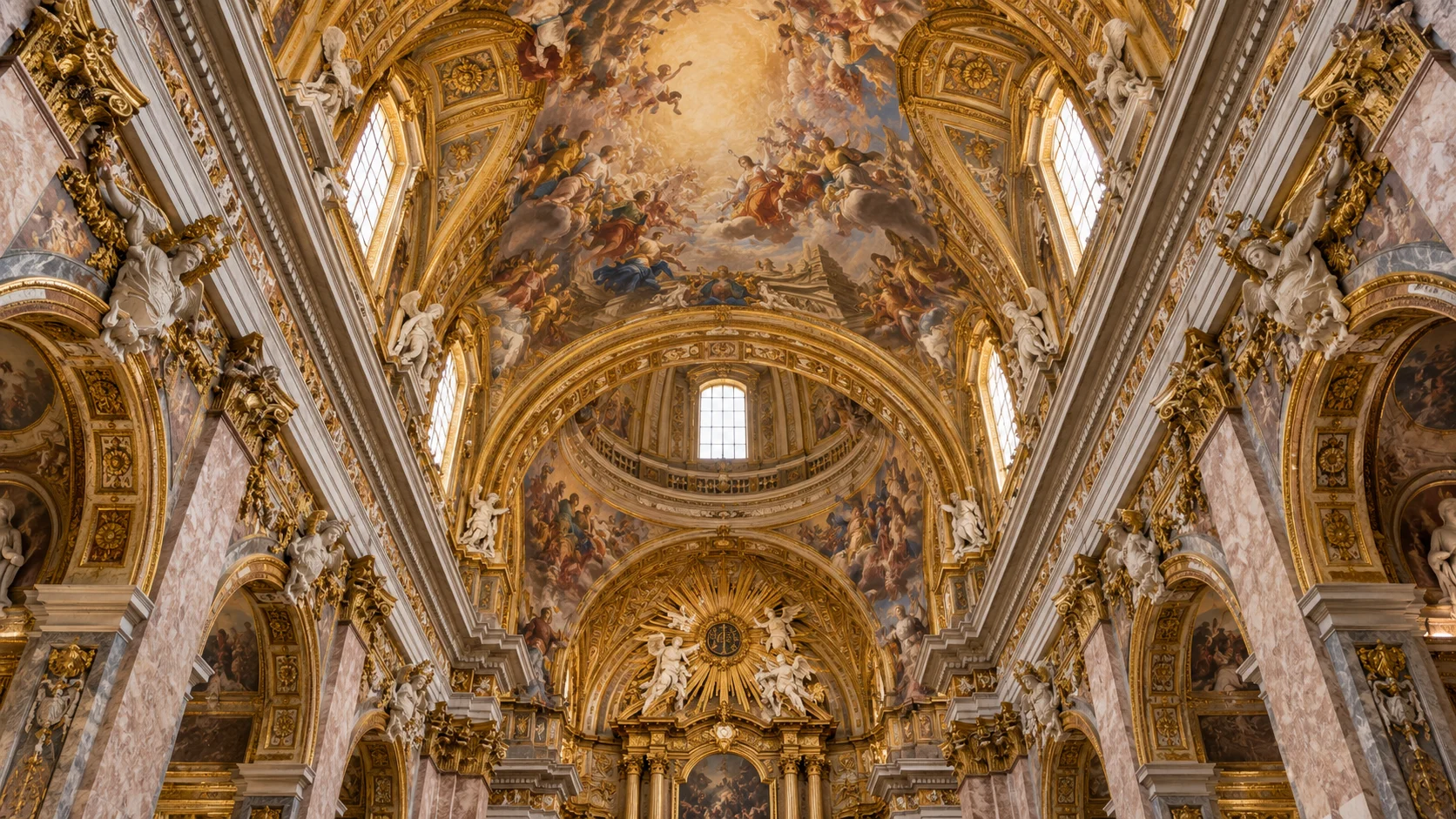
- The IHS at the center of the ceiling is a Christogram representing the name of Jesus. Start by finding where the light spreads from; this makes the scene much easier to read.
- Look for places where the boundary between the painting and the white stucco sculptures blurs. This effect comes from Baciccio’s painting and the three-dimensional decoration by Antonio Raggi and Leonardo Retti.
- Follow the route from the entrance to the ceiling fresco, then the Ignatius altar on the left and the Xavier altar on the right. You can connect the highlights in 15–20 minutes.
- The church is a place of worship. Pause your visit during Mass, and check the official guidance for your visit date about clothing, photography, and last admission time.
The interior route at a glance
Look up from the entrance, then move to the left and right transepts
From the central aisle, look at the ceiling first, then visit each transept. The diagram is directional and does not show the actual seating layout or dimensions.
-
1
Central ceiling frescoFrom near the entrance, first find the IHS and the center of the light.
-
2
Left · Chapel of St. IgnatiusSee the chapel and altar of the founder of the Jesuits.
-
3
Right · Chapel of St. Francis XavierThe altar houses relics of the missionary.
-
4
Apse and domeContinue your gaze through the scenes in the dome and apse.
이 도식은 실제 치수나 작품 배치를 재현한 평면도가 아니라, 관람 방향을 기억하기 위한 개념도입니다.
Day by day
Suggested itinerary
See each day's route, highlights, background and stay together in one place.
Stand in the middle of the aisle near the entrance and take in the whole ceiling fresco. Find the IHS and the center of the light, then look for places where the painting extends beyond its sculpted frame.
Go to the altar of St. Ignatius of Loyola. See the grand altar in the chapel that houses Ignatius’s remains, along with the curtain mechanism that opens when needed.
Cross to the altar dedicated to St. Francis Xavier. After seeing the altar, return to the central aisle and take another look at the balance of the ceiling fresco from left to right.
If time allows, look up at the dome and apse. See whether the dramatic light in the ceiling fresco carries through to the scenes at the back of the church, then leave quietly.
History and context
The Church of the Gesù is the Jesuits’ main church. Giacomo Barozzi da Vignola was responsible for its design and construction, which began in 1568. After Vignola’s death, Giacomo della Porta completed the work. The church’s official records distinguish between the completion of construction in 1575 and its consecration in 1584.
Giovanni Battista Gaulli, known as Baciccio, was commissioned to decorate the dome and nave ceiling in 1672. The nave ceiling fresco, The Triumph of the Name of Jesus, was created from 1676 to 1679 and unveiled on December 31, 1679.
Baciccio combined fresco painting with three-dimensional decoration. Thanks to his collaboration with the sculptors who created the white stucco decorations, the boundary between painted figures and real ornament blurs when viewed from the floor.
Places and meals
Use the IHS and the light at the center to read the scene. The dark figures at the edges and the boundary of the sculpted frame are key to the illusion.
Google MapsIt is in the left transept. The remains of Ignatius, founder of the Jesuits, are housed here. The chapel is known for its ornate decoration by Andrea Pozzo.
Google MapsAn altar in the right transept dedicated to the Jesuit missionary Francis Xavier.
Google MapsSeeing Baciccio’s “Paradiso” and “The Glory of the Mystical Lamb” in the apse together shows how the ceiling painting’s light and figures extend throughout the church.
Google MapsHow to fit it in
First, view the entire ceiling painting from the central aisle. Instead of trying to read every figure, follow the overall movement: light converges on IHS as figures recede into darkness on the opposite side. Next, see the altar of Saint Ignatius in the left transept, then cross to the altar of Saint Francis Xavier on the other side. If you have time, continue to Baciccio’s “Paradiso” in the dome and “The Glory of the Mystical Lamb” in the apse. The ceiling will feel like one continuous scene.
Reality check
The Church of the Gesù is on Piazza del Gesù. It is easy to combine with a walk to the Pantheon, Piazza Navona, and Campo de’ Fiori, but Rome’s central cobblestone streets can add travel time. Before setting out, check the walking route to your accommodation or next destination in Google Maps.
Allow 15–20 minutes to see the ceiling fresco and the two transept altars. Give yourself 30 minutes or more if you want to take your time with the dome, apse, and explanations. General visits may be restricted before and after Mass, so avoid squeezing this stop between tight reservations.
In the official guidance, prioritize checking Mass and opening times over admission fees or other visiting costs. If you need to know the cost of a donation, tour, or special program, confirm the terms through official information on site. Don’t pay unofficial street guides.
Keep quiet during Mass and prayer, and don’t approach the altar or block the aisles. Staying safe here starts with consideration for both visitors and worshippers. Follow the day’s guidance on tripods, flash, and permitted photography areas. In crowded squares and on public transportation, keep your bag in front of you.
If plans change
Avoid disrupting services. Walk around Piazza del Gesù or toward Campo de’ Fiori first, then return for the next opening time on the official schedule.
See the central ceiling fresco and the Chapel of St. Ignatius on the left. You can save the Xavier altar and dome for another visit without losing the overall flow.
Small tip
From close up, the boundary between the sculpture and painting is clearer. Step farther back to better see the illusion of figures cascading down from above. If a mirror or visitor aid is available to reduce neck strain, use it; availability may vary on your visit date.
Final check before departure
- Check the church’s official schedule for your visit date, including opening times, Mass, and pauses in tourist visits.
- Wear clothing that covers your knees and shoulders, and follow the entrance guidance on photography, flash, and tripods.
- Save the walking route to Piazza del Gesù and your next destination in Google Maps.
- To avoid keeping your neck tilted for too long, alternate between the central aisle and the back of the church as you view the ceiling fresco.
The church’s official guidance lists winter weekday hours as 07:30–12:30 and 16:30–19:30, and summer weekday hours as 07:30–12:00 and 17:00–19:30. Saturday, Sunday, and religious feast-day hours differ, and tourist visits stop 30 minutes before Mass begins. Check the official schedule again just before your visit for that date’s opening and Mass times.
Information checked: 2026-10-01