
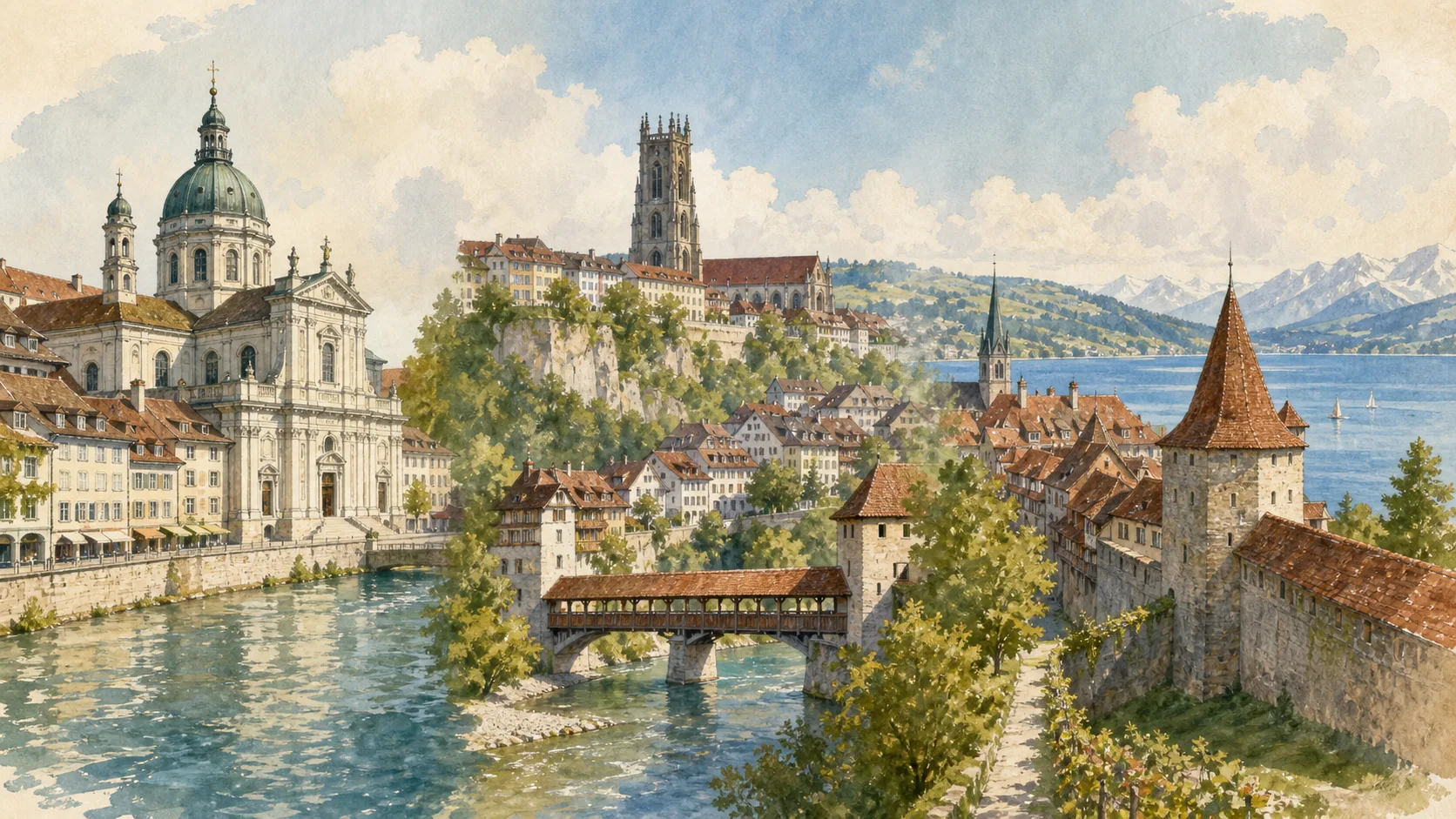
At a glance
- The takeaway is simple: don’t try to visit both Solothurn and Fribourg. See one, then continue to Murten.
- Choose Solothurn if you want to spend less time walking. The old town is close to the station, and you can see the cathedral and clock tower in 40–50 minutes.
- Choose Fribourg if scenery and historic lanes matter most. Allow at least 2 hours 15 minutes to walk from the cathedral down to the Lower Town along the Sarine River.
Choose one
Two day-trip options
Both routes end in Murten. Keep your visit to the first town on schedule so you have time for Murten’s town walls and lakeshore.
From Solothurn station, cross the Aare River and visit St. Ursus Cathedral, the Jesuit Church, and the clock tower, then return to the station the same way. Take a train toward Bern and transfer to Murten/Morat. In Murten, walk in this order: Bern Gate, Hauptgasse, the town walls, the exterior of Murten Castle, and the lakeshore.
- Spend only 40–50 minutes in Solothurn and return to the station at least 10 minutes before your train departs.
- If you have only 30 minutes, skip the interior of the Jesuit Church and see only the cathedral exterior and clock tower.
- Leave at least 2 hours 30 minutes for Murten. Allow 3 hours if you plan to eat as well.
Solothurn to Murten/Morat usually requires one transfer in Bern. Check train numbers and platforms on SBB on the day of your trip. Google Maps 길찾기
Walk from Fribourg/Freiburg station to St. Nicholas Cathedral. Look down over the Lower Town from the Zähringen Bridge, then descend through the Stalden lanes and cross the Bern Bridge. If the funicular is running, ride up to the Upper Town and return to the station. During a service suspension, take a bus or walk uphill. Then take a regional train to Murten/Morat and explore the town walls and lakeshore.
- Skip the cathedral tower’s 365 steps on a short visit and spend your time in the old town and Lower Town.
- Allow at least 2 hours 15 minutes, including the uphill return from the Lower Town to the station and time to wait for public transport.
- Don’t linger over a meal in Fribourg. Have a late lunch or snack in Murten’s old town instead.
Regional trains connect Fribourg/Freiburg and Murten/Morat. When the Fribourg funicular is out of service, allow an extra 25–35 minutes to get back to the station. Google Maps 길찾기
How to choose a town
The station is close to the old town, and the route is fairly flat. Baroque architecture spread during the years when French royal ambassadors stayed here, from 1530 to 1792. The number 11, which the town is fond of, appears repeatedly at St. Ursus Cathedral.
Founded in 1157, the town is divided into an Upper Town and a Lower Town along the Sarine River. To appreciate Fribourg’s dramatic change in elevation, go beyond the cathedral and descend through the Stalden lanes to the Bern Bridge.
The Battle of Murten took place here on June 22, 1476, when the Swiss Confederacy defeated the army of Charles the Bold, Duke of Burgundy. Look over the old town rooftops from the walls, then descend to the lakeshore to see both sides of the town.
Places and meals
Starting point for a short walk in Solothurn.
Google MapsThe bridge over the Aare River connecting the station and old town.
Google MapsBuilt from 1762 to 1773. On a short visit, start with the exterior.
Google MapsA Baroque church built from 1680 to 1689.
Google MapsSolothurn’s old clock tower, whose origins date back to the 13th century.
Google MapsStarting and ending point for the walking route in Fribourg.
Google MapsA Gothic cathedral built from 1283 to 1490. Its 74 m tower has 365 steps.
Google MapsA Fribourg viewpoint overlooking the Sarine River and Lower Town.
Google MapsSteep medieval lanes descending from the cathedral toward the river.
Google MapsFribourg’s last covered bridge; its current structure dates back to 1653.
Google MapsA wastewater-balanced funicular that opened in 1899. It will be out of service from August 27 to December 4, 2026.
Google MapsAbout an 8-minute walk to Murten’s old town.
Google MapsA landmark gateway to Murten’s old town. The current gate was rebuilt in the late 18th century.
Google MapsMurten’s main old-town street, lined with arcades and shops.
Google MapsViews of the old town’s red rooftops and the lake.
Google MapsA useful landmark when looking for the entrance to the town wall walk.
Google MapsIt is now used as administrative offices, so see the exterior and grounds.
Google MapsA place to rest by the lake after walking the town walls.
Google MapsFood and restaurants
- In Solothurn, try Solothurner Torte, a snack layered with hazelnut meringue and cream. Öufi means “11” in the local dialect and is also used in the name of a local beer.
- Fribourg’s Cuchaule AOP is a saffron bread. It is served with Moutarde de Bénichon, a sweet, spiced mustard. A well-known meal is moitié-moitié fondue, made with Gruyère AOP and Vacherin Fribourgeois AOP.
- Murten’s Nidelkuchen is a dessert baked with layers of cream on fermented dough. Both routes leave you plenty of time in Murten, making it easy to plan a meal or café stop here.
In short
If time is tight or you prefer a flat walk, go to Solothurn and then Murten. If you want to see more medieval lanes and river scenery and don’t mind hills, choose Fribourg and then Murten. I don’t recommend trying to fit all three towns into one day.
Reality check
The trip from Solothurn to Murten/Morat usually requires a transfer in Bern. From Fribourg/Freiburg, you can take a regional train to Murten/Morat. Don’t rely on memorized train numbers or platforms; check SBB for your actual travel date.
Option A needs 40–50 minutes in Solothurn and 2 hours 30 minutes to 3 hours in Murten. Option B needs at least 2 hours 15 minutes in Fribourg and 2 hours 30 minutes to 3 hours in Murten. Add 45–60 minutes for a meal.
Walking through the old towns and along Murten’s town walls is free. The cathedral towers, local transport, museums, and lake cruises cost extra. The listed 2026 Fribourg funicular fare is CHF 3 for an adult in Zone 10; check again before your visit.
Take shorter steps on Fribourg’s Stalden cobblestones and the steps along Murten’s town walls, especially in the rain, when they are more slippery. Choose Solothurn if Fribourg’s hills feel too steep. Churches may restrict visits during services.
If the walk doesn’t go as planned
Check bus service in the Lower Town, or walk uphill from the Bern Bridge toward the cathedral. Allow 25–35 minutes for the uphill walk back to the station.
Use Deutsche Kirchgasse and the path outside the walls to connect Bern Gate, the exterior of Murten Castle, and the lakeshore.
See Murten’s town walls and Hauptgasse first, then decide whether there’s time for the lakeshore. If you arrive in Murten too late, shorten your café stop or skip the church interior in the first town.
Small tip
Plan around your arrival time in Murten. If you’ll have less than 2 hours 30 minutes there, skip the church interior or café stop in the first town.
Final check before departure
- In the SBB app, check trips from your starting point to the first town and to Murten/Morat using your actual travel date.
- If you choose Fribourg, check whether the funicular and buses in the Lower Town are running.
- Check the sunset time and whether events will close Murten’s town walls.
- If you plan to visit a church or museum or take a boat cruise, check opening hours and whether reservations are required.
- All map links open using latitude and longitude rather than place names.
- Wear shoes suited to cobblestones and steps.
Sightseeing and travel conditions may change due to church services, town wall events, and railway work. The Fribourg funicular will not operate from August 27 to December 4, 2026. Enter your travel date and recheck SBB and local tourism board notices.
Information checked: 2026-09-06